
College of Arts and Sciences
Excellence in Undergraduate and Graduate Research Mentorship Awards
From 性福五月天 University's Division of Research & Economic Development性福五月天 University is pleased to announce the two winners of both the Excellence in Undergraduate Research Mentorship Award and Excellence in Graduate Research Mentorship Award. As part of the nominati鈥�
What's the Big Idea? Seeking a Deeper Understanding of the Mission of the Urban League
Hop on board as 性福五月天 President Todd Diacon engages with Elizabeth Smith-Pryor, associate professor of history with 性福五月天鈥檚 College of Arts and Sciences, as she conducts research on the impact of the Urban League.

Biological Sciences Researchers Study Tire and Road Wear Pollutants in Kent Campus Stormwater Wetlands
When driving in the rain, it is unlikely that you have thought much about how the environment is affected, let alone how nearby aquatic sources are impacted.

Honors Student Receives Distinguished May 4th Honors Memorial Scholarship
Honors College student Daniel Zalamea is a first-year 性福五月天 University student studying chemistry. He is the recipient of the May 4th Honors Memorial Scholarship, awarded to one member of each entering honors freshman class. Having only been a 性福五月天 student for a matter of months, D鈥�
Research Update: Studying neutron stars with gravitational waves
Neutron stars are some of the densest objects in the universe, and as such, the conditions at the cores of these extreme objects are impossible to reproduce on Earth. However, we can use data from the Laser Interferometer Gravitational Wave Observatory (LIGO) and the Virgo gravitational wave detector to gain insights into the physics of neutron stars.
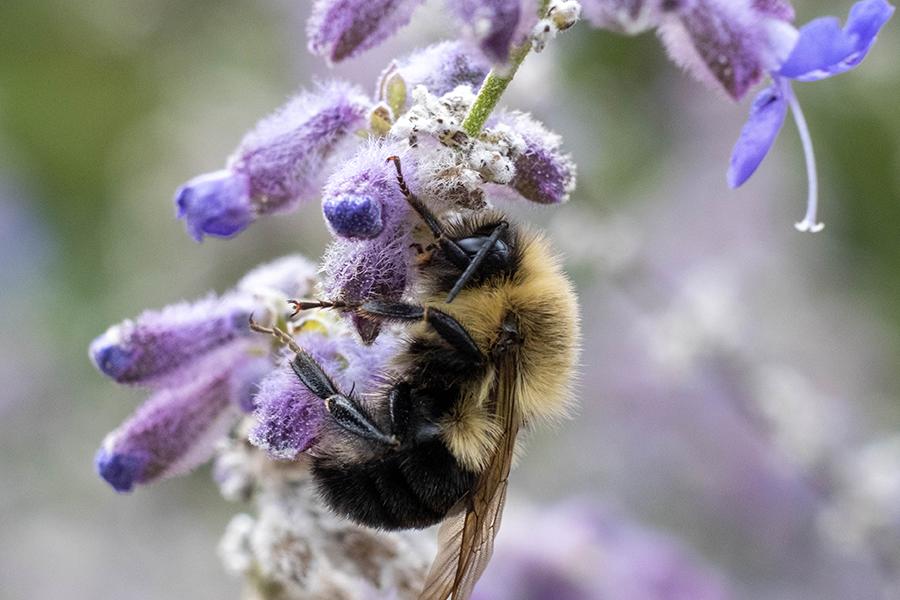
性福五月天 Biological Sciences Professor Helps Lead International Research Coordination Network to Study Insect Decline
Over half of the described species in the world are insects. Although many people think of insects as pests, they play vital roles and have a big impact on our invaluable ecosystems, as pollinators, helping break down wastes, and as an essential food source for many other organisms.
Physics professor receives DOE grant to study the quark-gluon plasma
Up until approximately 10^(-5) seconds after the Big Bang, the Universe was is a primordial state of matter called a quark-gluon plasma (QGP). This is due to the fact that the early Universe was extremely hot and in such a hot environment normal matter, e.g., atoms, atomic nuclei, and even neutrons and protons, did not exist.
Physics professor receives NIH grants to study membrane proteins
The National Institutes of Health (NIH) recently awarded a $1.86 million grant to Thorsten-Lars Schmidt, Ph.D., to develop molecular tools that help researchers to understand membrane proteins. As an add-on the NIH awarded Dr. Schmidt an instrumentation grant for a high-end Atomic Force Microscope.
Physics Professor receives R35 Grant from the National Institutes for Health
The National Institutes of Health (NIH) recently awarded a $1.86 million grant to Thorsten-Lars Schmidt, Ph.D., to develop molecular tools that help researchers to understand membrane proteins. As an add-on the NIH awarded Dr. Schmidt an instrumentation grant for a high-end Atomic Force Microscope.

Students Conduct Landscape Ecology Research to Discover Effects of Sea Level Rise
Saying "yes" to everything landed Kathryn Burns in the middle of New Jersey's coastal wetlands